A calculus overview
From Ames, Iowa
Numbers
The first thing to discuss is numbers. Then it will be necessary to talk about operations on them.
A number is a label for a quantity. A quantity can be equal to, greater than or less than another quantity. These relationships can be expressed with a single digit.
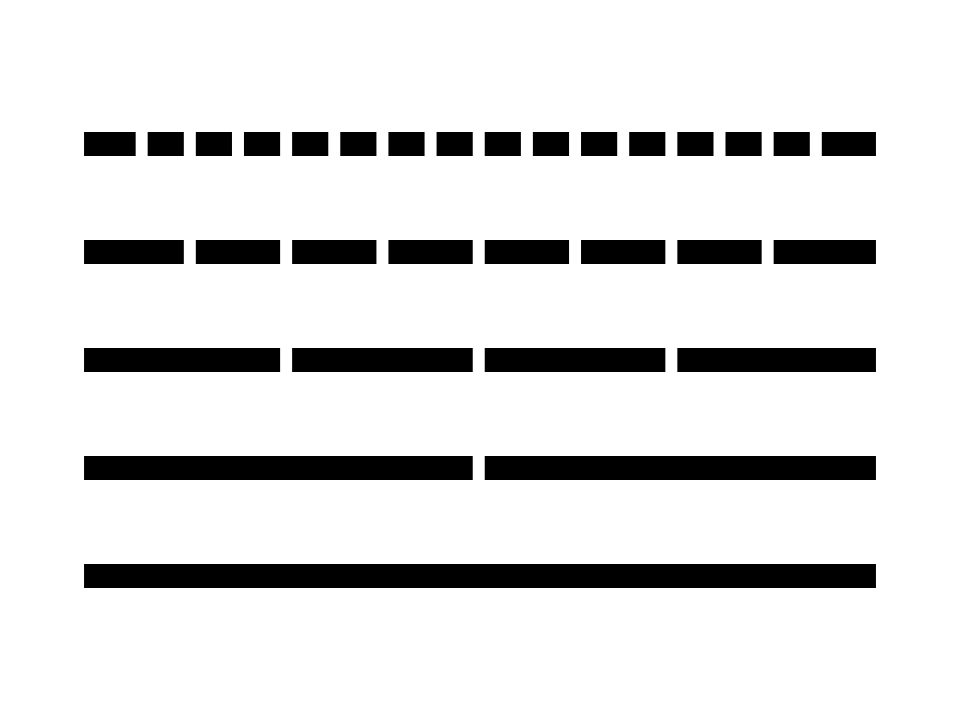
By using the binary number system to represent powers of 2, this can be refined for multiplie places.
- 101 =
- 0.101 =
- etc.
And this maintains the ability to order quantities:
- 0.101 > .011
- 0.010 < .1
- etc.
If a stick is broken in half, then half is broken in half again, etc. the total length of the stick doesn't change.
But if alternating terms are separated:
This is true because:
- Each term in the series is twice the value of the corresponding term in the series.
- 1 = 1x + 2x
is not directly a binary number like written above (since it includes a "3"). is a rational number. Rational numbers are numbers written as a fraction of two integers. Integers are the positive and negative whole numbers like -3, 0, 1, 2, etc. Can be written as a binary number?
Yes, given infinite terms, can be written in the binary number system. A binary number that ends in infinite "1"s has a finite equivalent (the stick analogy). But cannot be written in a finite number of terms:
- = .01
- = .0101
- = .010101
- = .01010101
None of the terms exactly equal . If they were placed in a sequence, they would get closer and closer.
A good description would be to say they converge. Mathematically, convergence means that for any arbitrarily small number ε (pronounced "epsilon" like "e" for error), there exists an index n in the series beyond which all terms after that place are within ε distance of each other. For any i1 and i2 greater than n:
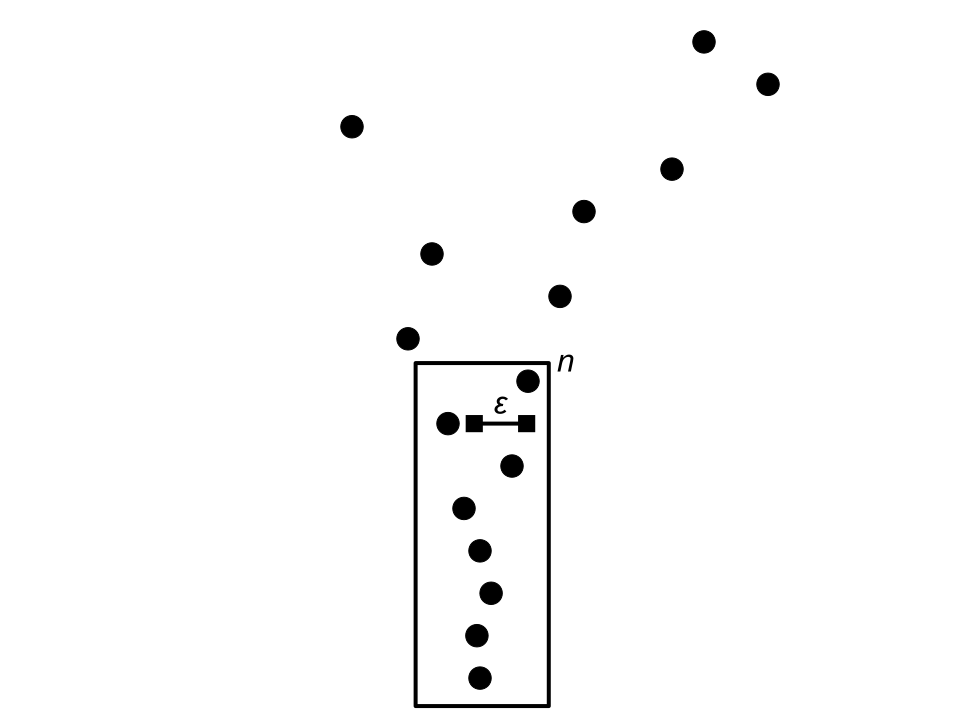
For example, given the sequence of approximations of was .
At any point in the sequence , all the remaining terms are within whatever the last added term was:
- (remaining terms all within )
- (remaining terms all within )
- (remaining terms all within )
- (remaining terms all within )
For any ε, there will be an with a last term that is smaller. The last term can be seen like . There always exists some x such that:
The sequence converges. What does it converge to? The limit (symbolized L) of a sequence is the number such that for any ε > 0, there exists a position n such that all indexes i greater than n have:
It was earlier seen the sequence would converge. If the binary number system was capped at finite places, the limit L that it converges to wouldn't be contained in that set.
The real numbers are defined so that if a sequence converges, it converges to a limit contained in the real numbers. This property is called completeness.
So far, binary number have been used. The real numbers aren't limited to that. Each place in a binary number represents a power-of-2. The real numbers generalize this to use any rational numbers.
There are several definitions of the real numbers. But the Cauchy definition of the real numbers ℝ works. A Cauchy sequence is any sequence of rational numbers that converges. The Cauchy definition of the real numbers is the set of all Cauchy sequences. This includes many sequences that would be considered "equivalent", but that can be ignored for now.
Additionally, with this definition, any sequence of real (not just rational) numbers also converges to a limit in the set of Cauchy real numbers.
Function limit
A function can formally be defined as pairs of an input real number and an output real number. But the familiar notation works well enough:
- f(x)
A limit1 of a function is the real number L approached by the output of the function f(x) as the input approaches a specific value a. This is similar to the definition of the limit of a sequence from above.
For any arbitrarily chosen maximum distance from the limit L to the f(x), ε:
- 0 < |f(x) - L| < ε
For every ε, there must exist a value δ ("delta", like d for distance) having inputs x satisfying the constraint:
- 0 < |x - a| < δ
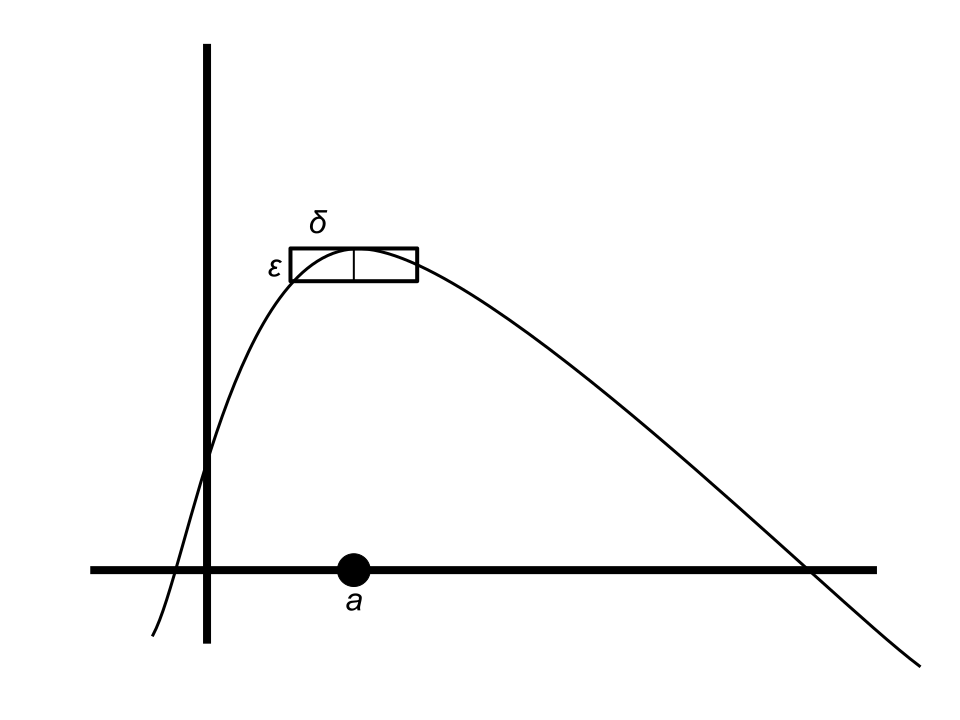
So there must be values of x that satisfy the conditions of δ, which in turn satisfy the conditions of ε.
To review, what is free to be chosen and what is dependent on that choice?
- ε can be chosen to be any arbitrarily small value. This represents the desired maximum distance between the limit L and f(x)
- δ is dependent on the value of ε. As ε gets smaller, δ should get smaller. If the aproximation of f(x) needs to be tighter, it makes more sense to force an input value closer to a.
Given the above conditions on L, f(x), ε and δ, the limit can be written:
The limit direct substitution rule
If f(x) can be directly evaluated at a, then that is the limit.
The limit sum rule
Limits can simply be added2. Given:
Then:
Written out using the definition of the limit above:
- For any ε, given 0 < |(k(x) + g(x)) - (K + G)| < ε
- There must exist a δ, such that 0 < |x - a| < δ
As a proof:
- For any ε > 0
- For |k(x) - K| < , by definition there exists σ1 such that 0 < |x - a| < σ1
- For |g(x) - G| < , by definition there exists σ2 such that 0 < |x - a| < σ2
- Defining σchosen = minimum(σ1, σ2)
- |(k(x) + g(x)) - (K + G)| = |(k(x) - K) + (g(x) - G)|
- |(k(x) - K) + (g(x) - G)| ≤ |k(x) - K| + |g(x) - G|
- |(k(x) - K) + (g(x) - G)| ≤ + (substituting back from 2nd/3rd line)
- |(k(x) - K) + (g(x) - G)| ≤ ε (which is the definition of what was to be shown)
Additional limit rules
By the limit constant multiple rule, the limit of a function multiplied times a constant, c ≥ 0, is the limit of the function multiplied by that constant.
The the limit product rule, the limit of two functions multiplied together, is the product of their limits.
These rules can be shown using a similar ε-δ approach to the limit sum rule above. There are some additional ones that require later topics like Derivatives, from below.
Integrals
Informally, an integral measures the surface or volume under a function.
There are a few definitions of this, but the Darboux integral3 works well enough. It's definition must be composed of several preceding definitions.
An interval is the set of all real numbers lying between two fixed points. It is written like [a,b] e.g. [4.327, 8.27].
A partition of an interval is a sequence x0, x1, x2...xn of real numbers such that a = x0, b = xn and x0 < x1 < x2 ... < xn.
A subinterval of a partition is any pair of [xi, xi+1]. The mesh or norm refers to the maximum length of any subinterval in the partion. Length is measured as |xi+1 - xi|. For example one partition of the interval [0,1] is:
- [0, .25]
- [.25, .75]
- [.75, 1]
The norm/mesh of the example above would be .5.
If a set S is a subset of a set P, every element in S is also in P.
The supremum (sup) of a subset S of a set P is the least element in P that is greater than or equal to each element of S, if it exists. It is sometimes called the least upper bound (LUB).
The infimum (inf) of a subset S of a set P is the greatest element in P that is less than or equal to each element of S, if it exists. It is sometimes called greatest lower bound (GLB).
The supremum and infimum are similar to the max and min of a set, but are different because they might not be contained in the subset. For example, the infimum of f(x) = on the set of 0 < x < 1 would be 0. But the set 0 < x < 1 does not contain 0.4
The Darboux integral definition uses these functions:
- Mi =
- mi =
So Mi is the least upper bound of f(x) in each subinterval and mi is the greatest lower bound on each subinterval.
The upper Darboux sum for function f(x) and partition P is:
- Uf,P =
The ∑ symbol is called a "sigma" (like "sum"). It symbolizes a series of terms added up, where each term uses i as a variable. The i takes each value from the bottom number to the top. For example:
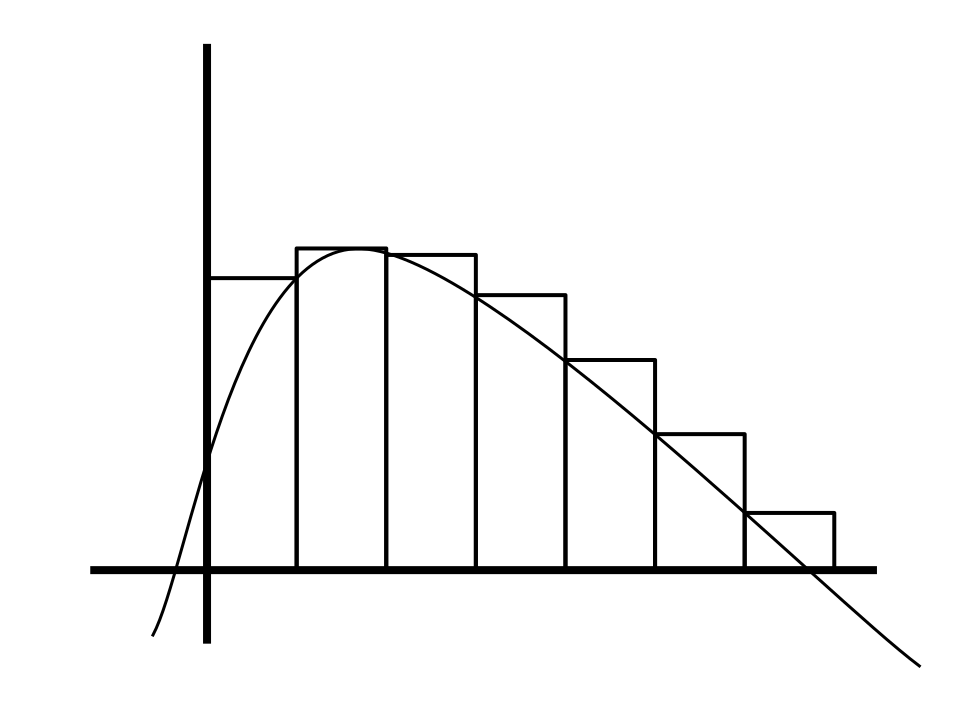
The illustration shows a for each subinterval. The height is the infinum of f(x) in that subinterval.
The lower Darboux sum is defined is defined for function f(x) and partition P:
- Lf,P =
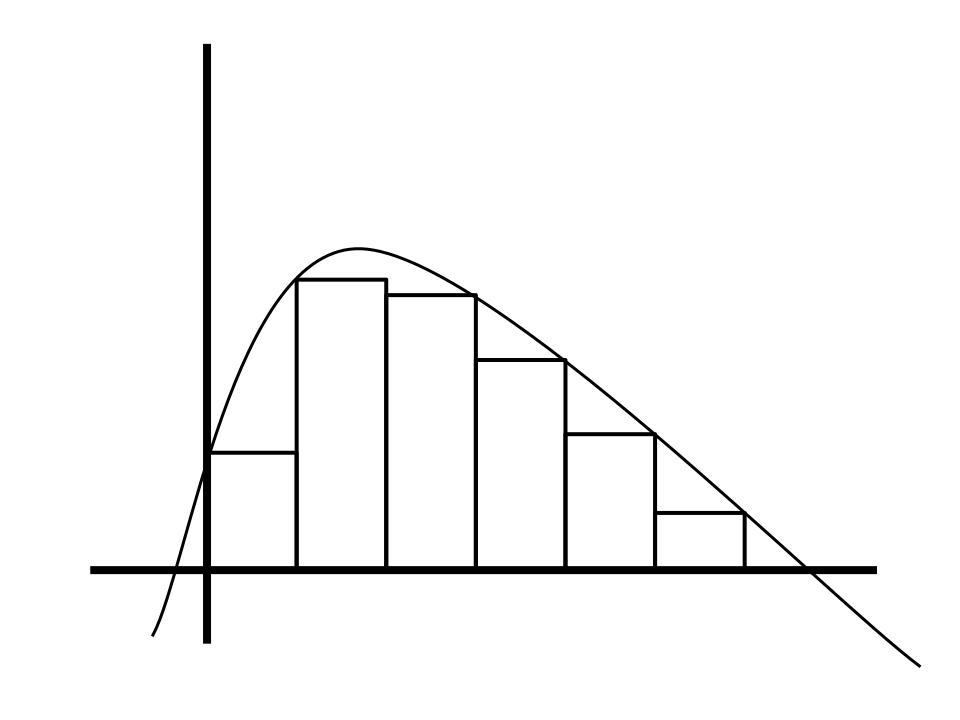
In this illustration, the rectangle heights are under the function f(x).
The upper Darboux integral is the infimum of the set of upper Darboux sums for every possible partition.
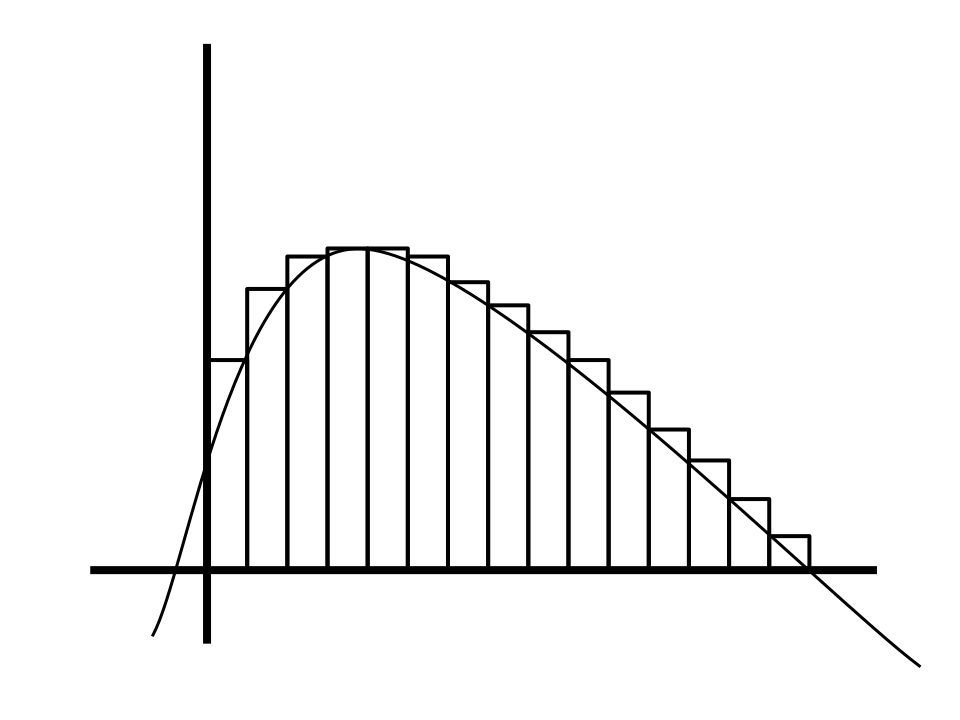
This illustration doesn't show the upper Darboux integral exactly. It shows the total area of the rectangles for this partition is less than the previous partition. The upper Darboux integral finds the partition with the lowest total area. This has the least excess area between the function f(x) and the top of the rectangles.
The lower Darboux integral is the supremum of the set of lower Darboux sums for every possible partition.
The condition to be able to evaluate an integral with the Darboux integral is either:
- The upper Darboux integral MUST equal the lower Darboux integral.
- For any ε > 0, there exists a partition such that Uf,P - Lf,P < ε
These 2 are equivalent. If either is met, the Darboux integral is the identical value of the upper or lower Darboux integral.
To properly prove the above conditions are equivalent, it would be necessary to show (a.) implies (b.) and (b.) implies (a.). A proof of this can be found here.
Side note: Guass's Pairing Method
There's a small prerequisite before the next section:
1 + 2 + 3 + ... + n =
As a proof5:
- S = 1 + 2 + 3 + ... + n
- S = n + (n-1) + (n-2) + ... 1 (same sum as last step, but backwards)
- S + S = (n + 1) + (n + 1) + ... + (n + 1) (adding both term-wise)
- S + S = (n + 1)n (there are n terms in S)
- S = (S + S = 2S)
Using the Darboux Integral to integrate a simple function
The Darboux integral is purposely defined to not require a uniform partition. The lengths of different subintervals can be different.
However, it's simpler to take n equal subintervals across [a,b] with:
- xi = a +
Given the function:
- f(x) = x
Even without a formal proof, this function obviously increases with x if x ≥ 0. So the infimum of each subinterval is f(x) at xi-1 and the supremum is f(x) at xi.
Substituting that into the definition of the upper and lower Darboux sums:
- Uf,P =
- Lf,P =
It's simpler to choose a = 0 for now. Since each subinterval is uniform, the length can be written in terms of the number n of subintervals:
- (xi - xi-1) =
Substituting this:
- Uf,P =
- Lf,P =
is a constant, so it can be moved outside of the sums:
- Uf,P =
- Lf,P =
Evaluating f(x) at each endpoint using the definition of xi from above:
- Uf,P =
- Lf,P =
is a constant, so it can be moved outside the series similar to what was done with earlier. Using the Guass Pairing from the prerequisite:
- Uf,P =
- Lf,P =
Regrouping and cancelling some terms:
- Uf,P =
- Lf,P =
For the integrability condition, for any ε:
The first terms inside each parenthesis cancel and:
n can be chosen arbitrarily large, so a partition always exists that satisfies the condition for any ε.
Informally, 0 < for all n. But is there another element in ℝ such that 0 < x < for all values of n? No. So the infimum of the set of upper Darboux sums for every possible partition is:
- Uf =
The same approach could be used to find Lf. So this is the value of the Darboux integral, which matches what is generally taught in introductory calculus courses.
Derivatives
The derivative of a function can be thought of as the slope of a line tangent to the function at a specific point. It also acts as the reverse operation of integration.
The derivative of a function f(x) at a point a is:
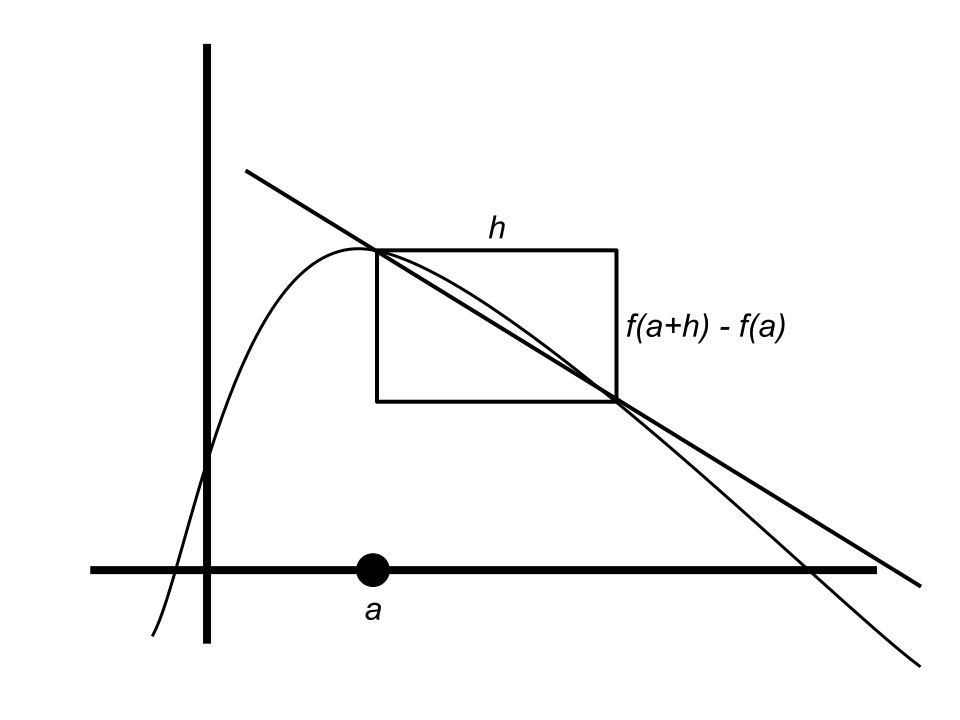
A Simple Derivative
Given the result of the earlier Darboux integration:
- f(x) =
Plugging into the derivative formula:
By applying the FOIL method:
By combining the top two terms and moving the bottom denomenator up:
Eliminating the positive and negative terms and separating the terms by variables:
The in the numerator and denomenator in the middle term can be cancelled. The last term drops out since h goes to 0.
Since h is now eliminated, the limit L is equal to a. This was the original f(x) example that was integrated in the integration section, so the integration has been "reversed".